F1 Safety Car Explained: How It Neutralises a Race and Shapes Strategy
The Safety Car is the official tool Race Control uses to neutralise a Formula 1 race when the track is unsafe. Deployed to allow marshals and officials to clear incidents or make the circuit safe, the Safety Car leads the field at reduced speed and enforces strict rules that reshape gaps, tyre management and pit‑stop decisions.
Quick summary
The Safety Car neutralises a race so officials can clear hazards. Race Control orders deployment and withdrawal; cars must queue behind the Safety Car and obey light/flag signals. The Virtual Safety Car (VSC) is a non-physical neutralisation with a prescribed minimum lap-time delta. Unlapping procedures allow lapped cars to pass under specific instructions. Safety-car periods compress gaps and often create low-cost pit-stop opportunities that teams exploit strategically.
CLEAR DEFINITION
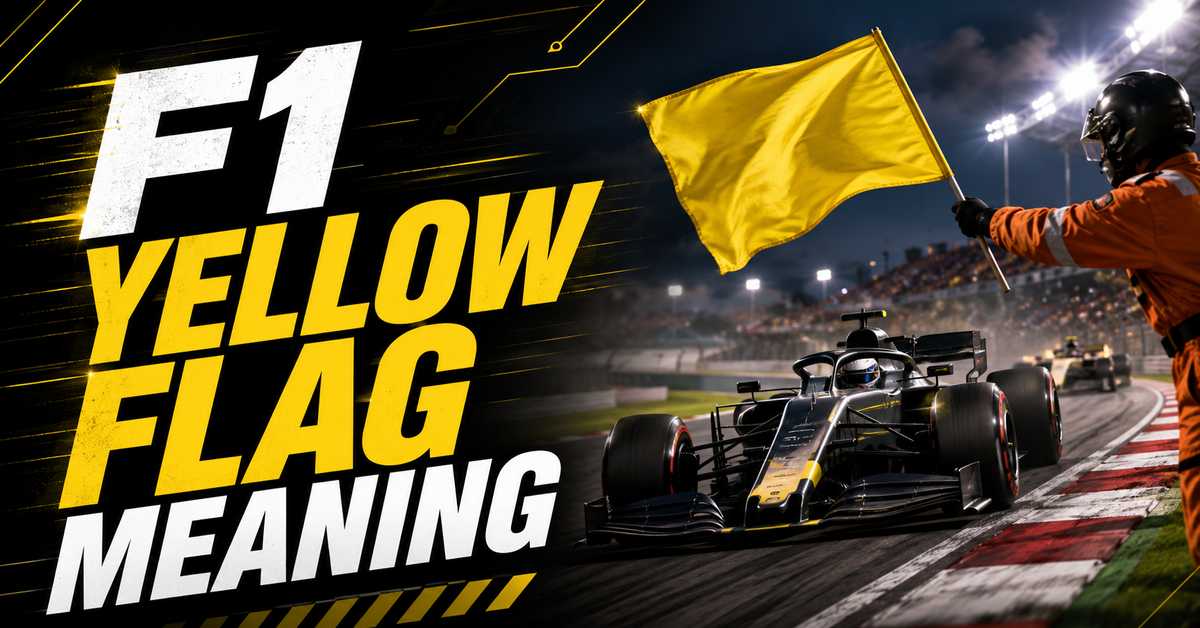
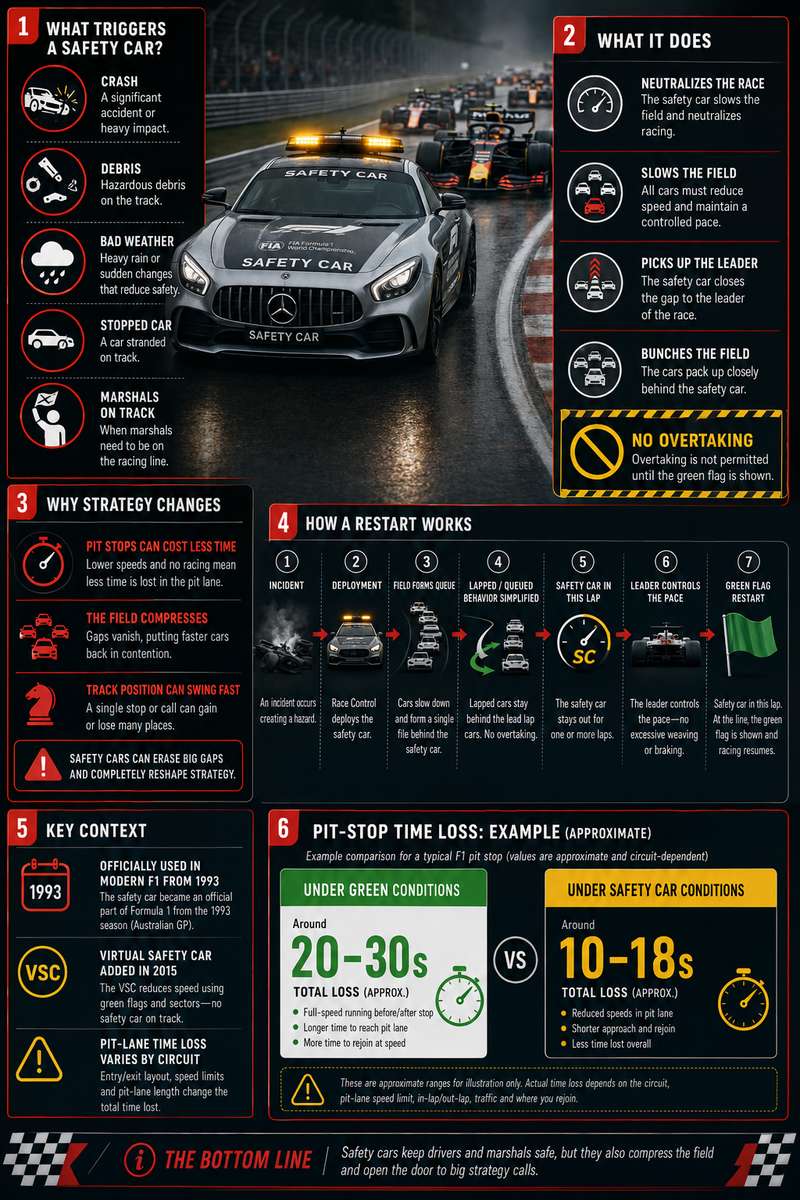
The Safety Car is a car used to neutralise a race, lead the field at reduced speed, and allow marshals and officials to clear incidents or make the track safe. Race Control — typically the Clerk of the Course or Race Director — decides when to deploy or withdraw it. Officials signal the intervention with marshal panels, light panels showing 'SC', and waved double‑yellow flags.
HOW IT WORKS
When Race Control deploys the Safety Car, all competitors must form a queue behind it; overtaking is prohibited except for narrow, regulated exceptions. Drivers must avoid erratic driving and adhere to minimum sector times and the reduced speed intent. The Safety Car leads at a pace slow enough for safe recovery work but fast enough to keep tyres and brakes from cooling excessively.
The Virtual Safety Car (VSC) is a separate procedure used when a slower but controlled pace is required without sending the physical car onto the circuit. During a VSC drivers must keep above a prescribed minimum lap‑time delta and overtaking is not allowed; the VSC maintains safe conditions while avoiding a physical bunching of the field.
UNLAPPING PROCEDURE AND RESTARTS
The FIA provides a specific unlapping procedure under the Safety Car. Race Control may issue the message 'LAPPED CARS MAY NOW OVERTAKE' (or equivalent). When that instruction is given, lapped cars are required to pass the cars on the lead lap and the Safety Car, then rejoin at the back of the line. The Safety Car will normally return to the pits at the end of the following lap unless still required to manage the situation.
RULES AND FIA PROCEDURES
The 2025 Formula 1 sporting regulations codify Safety Car and VSC behaviour including communications, overtaking exceptions, and pit‑lane rules while neutralised. Race Control communicates clear messages (for example, the timing of Safety Car withdrawal) and monitors compliance; breach of the rules can lead to sporting penalties under the regulations. Marshal panels and light panels provide the visual signals teams and drivers rely on during an intervention.
STRATEGY AND RACECRAFT
Safety Car periods have major strategic consequences. Because cars circulate at reduced speed behind the Safety Car, the time lost for a pit stop during an SC is smaller than under green-flag conditions. That makes an SC an opportunistic time to change tyres and reshuffle strategy—teams often take a "cheaper" stop and adjust a planned two‑stop or one‑stop strategy accordingly.
Moreover, the Safety Car bunches the field and removes previously established gaps. That can erase a leader’s advantage and give rivals a chance to attack on the restart, or conversely it can protect a leader by freezing tyre wear and limiting the effect of mechanical or tyre issues. The net effect depends on the intervention's timing, the remaining pit windows, and the circuit's overtaking characteristics.
CAR BEHAVIOUR, TYRES AND PACE
Neutralised running changes tyre temperature and brake heat trajectories. Drivers work to keep tyres and brakes in an operable window while following the Safety Car, using brake warming techniques and aggressive steering inputs when permitted. Cooler tyres reduce mechanical grip for the restart, making the first corners after an SC especially treacherous and important for racecraft and defensive driving.
SAFETY AND RISK
The primary purpose of the Safety Car is safety: to protect marshals, drivers and other track users while incidents are cleared. The Safety Car and VSC reduce the risk of further collisions during on-track recoveries. Clear procedures and visible signals are essential; they standardise behaviour so marshals can work with predictable on-track conditions.
COMMON MISUNDERSTANDINGS
Beginners often assume the Safety Car always benefits those who pit; in reality the advantage depends on pit‑lane time loss relative to rivals, track position, and the number of cars that pit. Another common confusion is mixing the Safety Car with the VSC: both neutralise the race but VSC keeps cars spaced by enforcing a lap‑time delta, while the Safety Car physically bunches the field behind it.
FAN VIEWING GUIDE
On television look for the 'SC' light panels, double‑waved yellow flags, the timing graphic's delta changes and team radio messages confirming Race Control instructions. During an unlapping call you will hear the message on team radio and see lapped cars peel off to overtake the Safety Car and the leaders before rejoining at the back of the queue.
CLOSING INTERPRETATION
The Safety Car is where safety, regulation and strategy converge. It is a safety tool that also functions as a major tactical variable—compressing gaps, altering tyre dynamics and creating pit‑stop value. Understanding the Safety Car and the VSC helps fans read a Grand Prix as a series of controlled interruptions where timing and communication are as decisive as outright speed.
Author: William L.