How do drivers get into Formula 3? The real steps behind an F3 seat
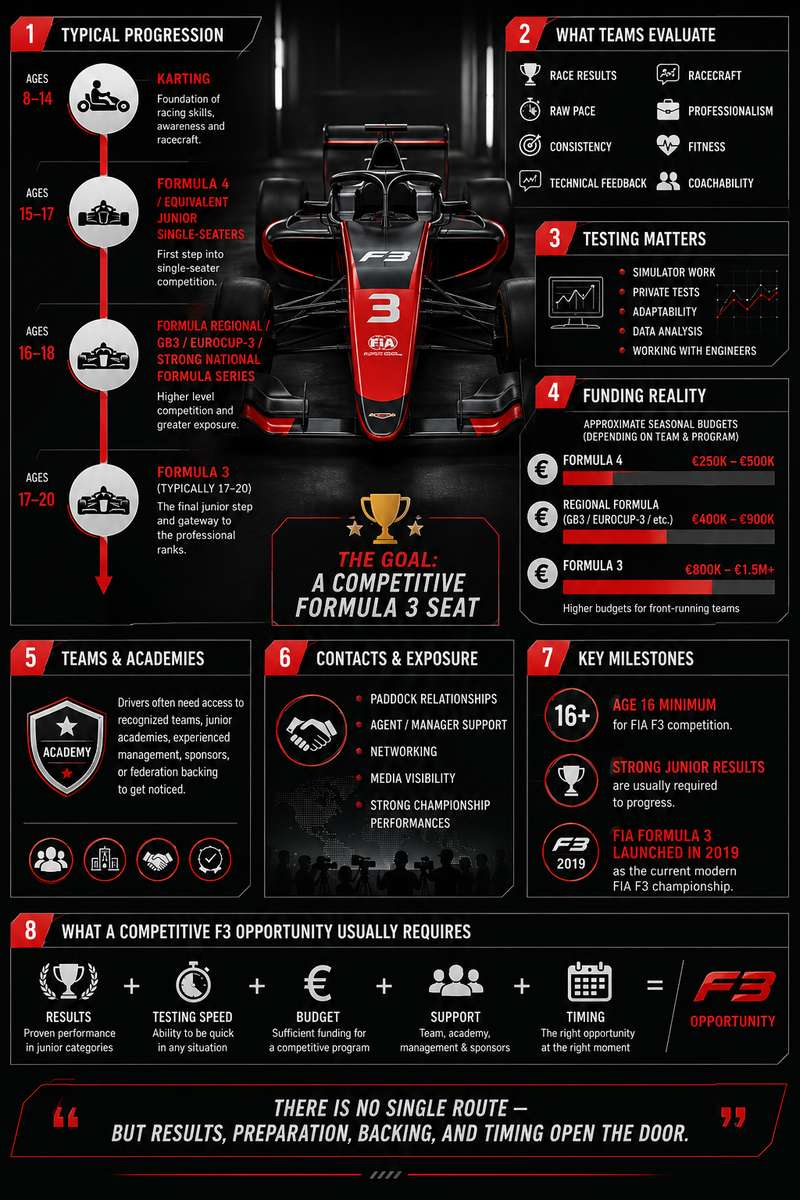
Want a short answer? Drivers usually reach FIA Formula 3 after success in karting, strong results in national FIA Formula 4 or regional Formula championships, and convincing teams with testing, simulator work, funding and academy links. That explains the headline route — but it misses the real mechanics that decide who earns a competitive F3 seat.
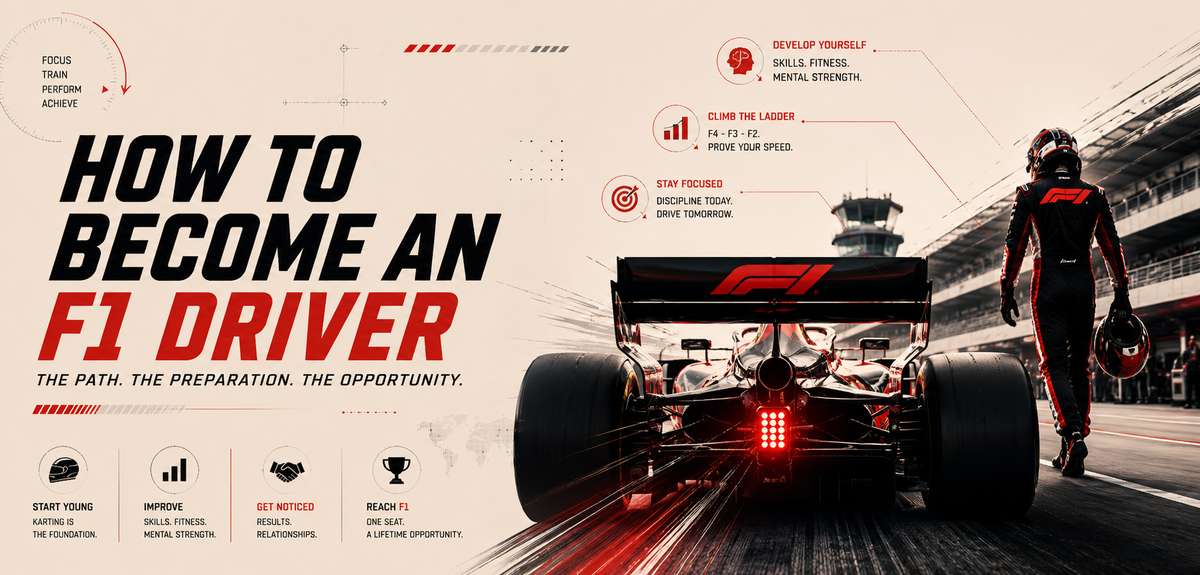
The simple ladder (karting → F4/regional → F3 → F2 → F1) is accurate in structure, but the decisive moments are selection points where results meet money, testing performance and relationships. Read on to understand what each of those factors actually means for a driver’s prospects.
Direct answer
Drivers get into FIA Formula 3 by combining strong on-track results in karting and FIA-certified junior single-seaters, demonstrable testing and simulator performance, and access to funding or academy support that makes them attractive to F3 teams.
What this article explains
- Why results matter and where they are first judged (karting, F4, regional series).
- How testing, simulator work and academies change selection odds.
- Why team relationships and funding influence who gets competitive seats.
Define the real target: what an F3 seat represents
FIA Formula 3 sits between national/regional single-seaters (F4 and Formula Regional-type championships) and FIA Formula 2. It is an international, single-seater championship intended as a clear step on the pathway toward Formula 1. A competitive F3 seat means a driver will race against an international field and be evaluated on race weekends where teams are actively scouting talent for F2 and Formula 1 academies.
Early foundations: karting and national single-seaters
Most drivers who reach F3 begin with karting and then move into national FIA Formula 4 or equivalent regional single-seaters. Success in those categories — race wins, podiums and championship positions — is the primary selection signal teams use to identify candidates for F3. The FIA explicitly links karting and FIA-certified junior formulas with progression through the single-seater ladder.
Testing, simulator work and demonstrable performance
On-paper results open doors, but teams also test candidates directly. That includes official pre-season tests, private on-track sessions and simulator evaluations. Strong testing performance shows a driver can adapt quickly to a heavier, more aerodynamically affected F3 car and provide useful engineering feedback.
Teams weigh testing and simulator data alongside race form because it reduces the uncertainty of signing a junior they have not seen in similar machinery.
Driver academies, relationships and introductions
Manufacturer and Formula 1 team driver academies are a major route into F3. Academies can provide financial backing, testing opportunities and introductions to top F3 teams. F3 teams often work closely with academies and talent scouts to place promising juniors, so being in an academy changes how a driver is evaluated and who will consider them for a seat.
How F3 teams select drivers
Teams recruit drivers based on a combination of factors: recent race results, testing and simulator performance, the funding or sponsorship a driver brings, and existing relationships with academies or managers. Team plans matter too — a team may prioritise a proven race winner, a promising rookie with academy backing, or a funded driver who secures the budget to run the car for a season.
Funding and cost realities
Affordability remains a material factor. The FIA and championships have introduced cost-control measures—standardising cars and limiting certain variable costs—to reduce the burden on entrants, but seat and running costs still influence selection. There is no single published per-seat figure for F3; budgets vary by team, testing needs and time spent in private programmes. The diversity of budgets in junior formulas (and the existence of lower-cost alternatives that advertise capped budgets) illustrates that costs are variable but decisive.
Where the FIA Super Licence fits in
Results in junior championships contribute to eligibility for the FIA Super Licence through a points system. Success in higher-level junior formulas helps a driver accumulate those points, making performance in F3 important for anyone who ultimately aims for Formula 1. The FIA publishes the Super Licence points table showing how championships contribute to licence eligibility.
The talent funnel: where many promising careers stall
Progression is not automatic. The pathway narrows sharply because F3 seats are limited and teams select using the mix of results, testing, funding and relationships described above. A strong season in F4 or regional series is necessary to be considered, but it is not always sufficient: timing, the availability of funded seats, and academy interest can determine whether a driver gets a competitive package or ends up on waiting lists or in lower-cost alternatives.
What matters most to teams (beyond raw speed)
Teams value repeatability, fast adaptation to new machinery during tests, useful technical feedback and professional presentation — including media skills and sponsor relations. A driver who pairs consistent race results with demonstrated testing speed and clear commercial or academy backing becomes far more attractive than one with isolated flashes of speed but limited support.
Practical next steps for an aspiring driver
If you are aiming for F3, focus on championship performance in FIA-certified junior categories, seek testing opportunities that prove adaptability to F3-style cars, and pursue relationships with driver programmes or teams. Building a commercial case — showing how sponsors or family funding can make a seat affordable to a team — is as practical as improving lap times when it comes to securing a competitive drive.
Final verdict: realistic, achievable — but conditional
Yes, there is a clear route into FIA Formula 3: karting, then strong form in national FIA Formula 4 or regional championships, followed by convincing testing and the right funding or academy support. But the pathway is conditional: results alone open the door, testing and simulator performance close it, and funding or academy relationships often decide whether that door leads to a competitive seat or a marginal one.
Understanding those mechanics — which parts are performance-based and which are structural or commercial — is the practical step every ambitious junior must treat seriously.
Author: William L.