What Age Do F1 Drivers Start Karting — The Real Answer and Why It Matters
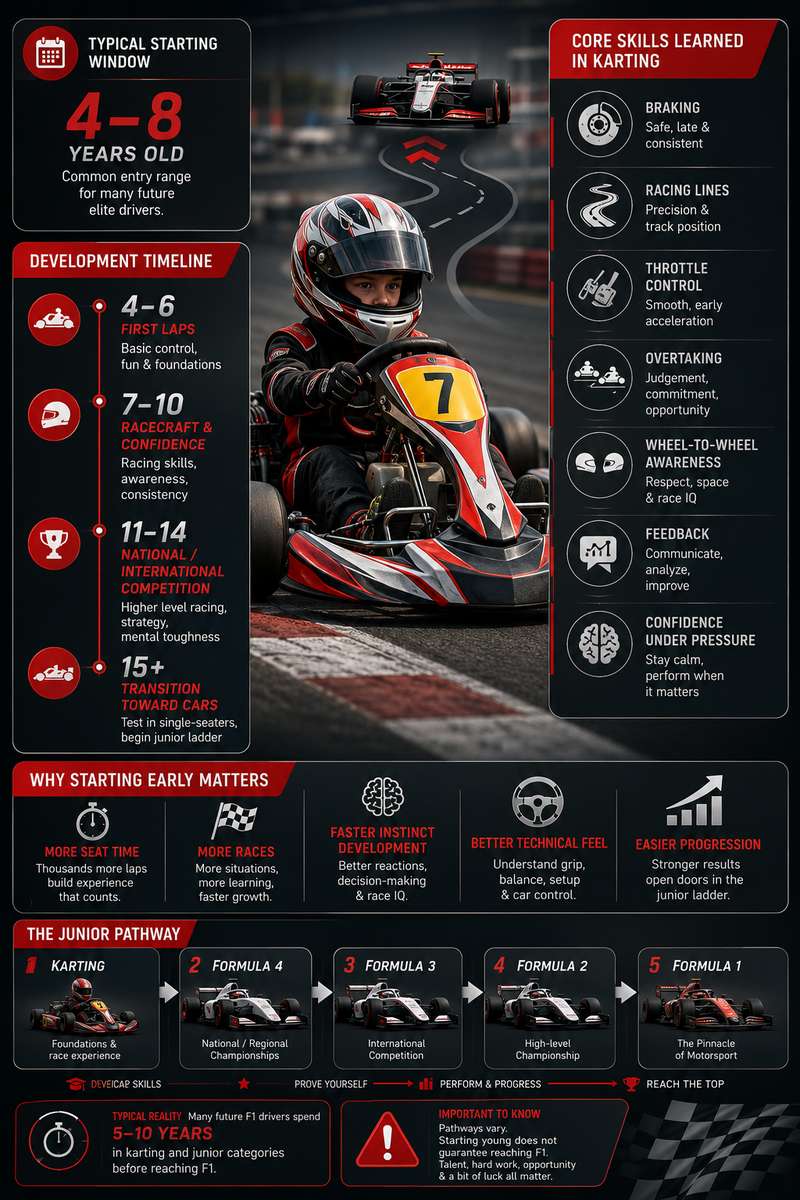
If you’re asking "what age do F1 drivers start karting?" the short, evidence-backed answer is clear: most top-level drivers begin in early childhood — commonly between ages 4 and 8, with many starting around 5–7. That early window gives far more than a head start in raw speed.
But naming an age is only the first step. The deeper reality explains why those early years multiply into decisive advantages: what is learned in a kart at seven is still guiding a driver’s instincts when they arrive in single-seaters years later.
Direct answer
Evidence shows most current top drivers began karting between about 4–8 years old (commonly around 5–7). Two well-documented examples: one began at age 4 and was competing by 7; another began at age 6.
What this article explains
- Why starting between 4–8 creates measurable advantages beyond simple speed.
- The core skills karting builds that transfer into single-seaters.
- How early experience affects visibility to academies and the single-seater pathway.
- Realistic alternatives for later starters and where careers usually narrow.
Racing a car isn’t the same as reaching Formula 1
Begin by separating two facts: karting is the established entry point into single-seater development, and Formula 1 is the narrow end of a long funnel. The FIA and CIK-FIA recognise organised karting and its junior categories as the primary feeder into Formula 4 and beyond. That formal pathway means early karting is the normal first contact with structured competition, rules, licence systems and talent identification.
Why starting at 4–8 produces a long-term edge
Three fundamental mechanisms explain the advantage of early karting.
- High-volume, early seat time: Children who start between about 4–8 accumulate far more hours of competitive driving before moving into cars. That seat time builds muscle memory for throttle and brake modulation, steering precision and how to exploit a limited mechanical grip window.
- Accelerated racecraft development: Karting’s close-quarters racing forces kids to learn defensive lines, overtaking timing and starts under pressure. These are tactical skills that later single-seater performance depends on heavily.
- Visibility to talent pathways: Early success and consistent exposure in karting increase a young driver's chances of being noticed by teams, academies and development programmes which can provide support later in the ladder.
What karting actually teaches that matters in cars
Karting transfers a compact set of foundational skills that persist when a driver moves to single-seaters:
- Vehicle control at the limit: recognising and reacting to understeer and oversteer, managing the balance between throttle and steering inputs, and developing a tactile feel for grip.
- Racecraft and spatial awareness: judging gaps, executing overtakes, defending lines and negotiating traffic—skills honed by wheel-to-wheel junior kart races.
- Starts and short-race tactics: karting sharpens launch technique and the split-second decisions used in qualifying and sprint-format races.
- Situational judgement: reading flag signals, tyre behaviour at a small scale, and the mental sequencing of multiple corners—abilities that scale up when aerodynamics and tyres change in cars.
Regulatory context and the trend toward younger categories
The CIK-FIA governs karting categories and sets minimum international licence ages for junior competition. Over recent decades, karting categories have trended younger and regulatory bodies have been paying closer attention to minimum ages and safeguarding because of that shift. The organised nature of karting and its age-based classes is part of why starting young has become the norm for drivers who later reach the top level.
How early karting links into the single-seater ladder
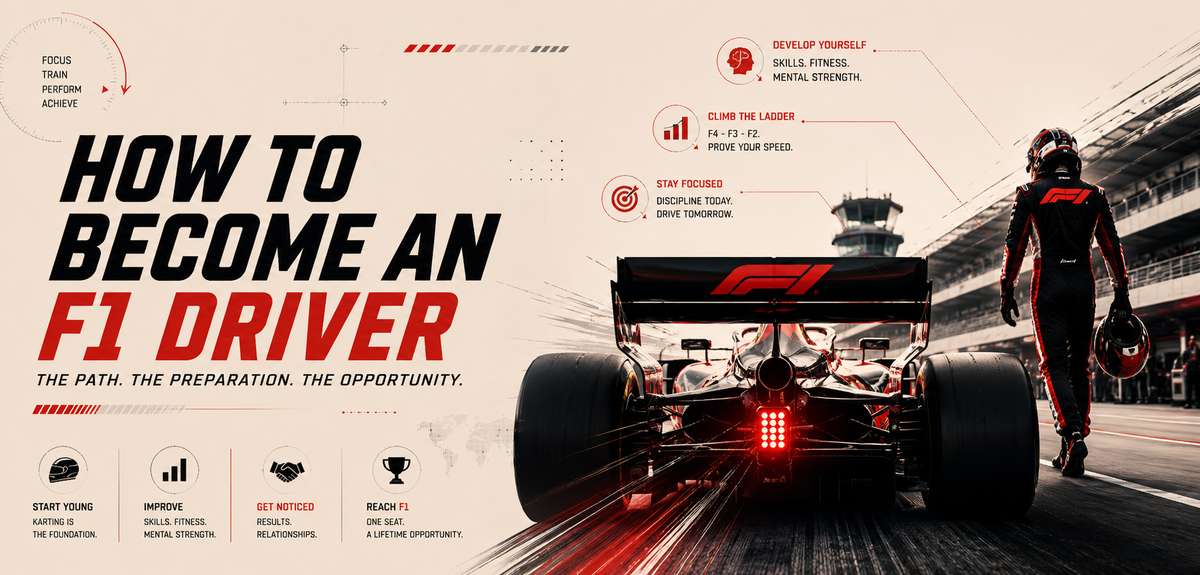
Because the FIA recognises karting as the primary entry, young drivers who show pace and racecraft typically move from national and international karting categories into entry-level single-seaters such as FIA-recognised Formula 4. That step requires both sporting results and the logistical backing—coaching, team support and funding—so early karting often functions as both training and audition for the next stage.
Where the early advantage compounds—and where it can stop
Early experience compounds across three dimensions:
- Skill depth: small control inputs and race instincts become automatic.
- Competition experience: handling season-long pressure, championship strategy and media or sponsor attention.
- Access: being seen by academies or teams that can help finance or place a driver in stronger programmes.
But the pathway still narrows. Financial demands, the availability of seats in higher categories, and the need to adapt from karts to aerodynamically sensitive cars are decisive filters. Early karting improves the odds but does not force a straight-line career to Formula 1.
Is it too late if you start later?
Starting after the early childhood window does not remove every possibility in motorsport, but it changes the practical reality. Later starters face a steeper learning curve in measurable seat time and racecraft against peers who already have years of competitive instinct. They may need a more intense, structured programme to compress learning—coaching, focused testing, and strong results in limited seasons—to catch up and gain the attention of development programmes.
Talent, training and what teams actually look for
Teams and talent scouts look for more than a single fast lap: repeatability, race intelligence, tyre sensitivity, technical feedback and adaptability matter as much as outright speed. Early karting tends to reveal and refine these qualities during formative races; that’s why early starters often present a fuller profile when evaluated for academy or team support.
Practical next steps for someone who cares about this question
If you or a young driver is deciding when to begin, these actions are the most concrete:
- Join structured karting competitions appropriate to age and licence level—this is where racecraft develops.
- Prioritise high-quality coaching and regular seat time rather than occasional track days.
- Use karting results and consistent progress to attract team attention or scholarship opportunities that help bridge the cost barrier.
Final verdict: the honest, useful answer
Most future Formula 1 drivers begin karting between about 4 and 8 years old, commonly around 5–7. That early start matters because it builds muscle memory, racecraft, and visibility long before the single-seater ladder begins. However, starting later does not close all doors in motorsport—it simply raises the bar for how quickly a driver must learn, perform and secure support.
In short: an early karting childhood creates a measurable and enduring advantage, but the pathway to professional racing remains shaped by results, adaptation to cars, funding and the narrowing pool of available seats.
Author: Cynthia D.