Martin Brundle: What early crashes and pressure moments reveal about his…
Martin Brundle's formative years in Formula 1 were marked by high-pressure episodes, painful crashes and a recovery arc that shaped both his driving and later perspectives as a commentator. Examining documented incidents from 1984–1987 and his subsequent resilience helps us understand how a driver learns to judge the limit, balance aggression and manage risk under extreme conditions.
Brundle's documented crashes — most notably the Dallas practice accident in 1984, his Monaco practice incident the same year, and a chaotic start incident in Austria 1987 — provide concrete anchors to analyse how risk perception, injury and experience change a driver's approach to the limit.
Where risk lives in Formula 1, with Brundle's early examples
Risk in Formula 1 is concentrated at a few predictable moments: high-speed kerb and barrier proximity during practice and qualifying; busy start and restart sequences; and unstable track surfaces in changeable weather. In Brundle's case the verified record singles out two practice crashes in 1984 — one at Monaco and one far more severe at Dallas on 24 June 1984 — and a chaotic start incident in Austria in 1987. These episodes illustrate different risk domains: a street-circuit practice crash linked to circuit-specific limits, a career-altering high-energy accident with severe injury, and a start-line collision where crowding and reaction windows compress decision-making.
Reading the edge of grip: what the incidents imply
Public accounts and Brundle's own retrospective comments show he experienced multiple sessions where the car's limits yielded abrupt consequences. Street circuits such as Monaco present narrow margins at high kerbs and barriers; practice there is a time to find confidence but also a place where a small misread of grip can end a session in a barrier. The Dallas crash is documented as a very severe injury sustained in practice — a reminder that finding the edge can carry disproportionate consequence when track runoff and barrier placement are unforgiving.
Braking commitment and escape margin
Braking decisions in tight street circuits and during high-speed approaches depend on available escape routes and the mechanical braking limits. The verified incidents emphasise that when circuits offer limited runoff, the acceptable margin for late braking contracts sharply. Brundle's Dallas accident — which resulted in multiple fractures and a prolonged recovery — underlines how a misjudgement or an unexpected instability at the limit becomes far more consequential where escape margin is minimal.
Wheel-to-wheel judgement and startline pressure
Starts condense risk: many cars, limited manoeuvring space and split-second reactions. The 1987 Austrian Grand Prix start incident involving Brundle, which caused a red flag, is an example of how initial acceleration phases can explode into multi-car incidents. Such moments test a driver's spatial judgement, reaction hierarchy and tolerance for collision risk. Contemporary lists of chaotic start incidents cite that event to illustrate how tightly packed grids amplify small errors into race-stopping collisions.
Wet conditions and unstable track states
While the verified material does not attribute a specific wet-weather crash to Brundle, the broader pattern in his early career — multiple practice and start incidents — aligns with how drivers confront evolving grip levels. When track adhesion changes, the driver's task is to re-evaluate braking points, turn-in aggression and throttle modulation continuously. The documented episodes from Brundle's career highlight the learning curve that comes from repeated exposure to sessions where grip can be deceptive or margins suddenly shift.
How experience and recovery reshaped decision-making
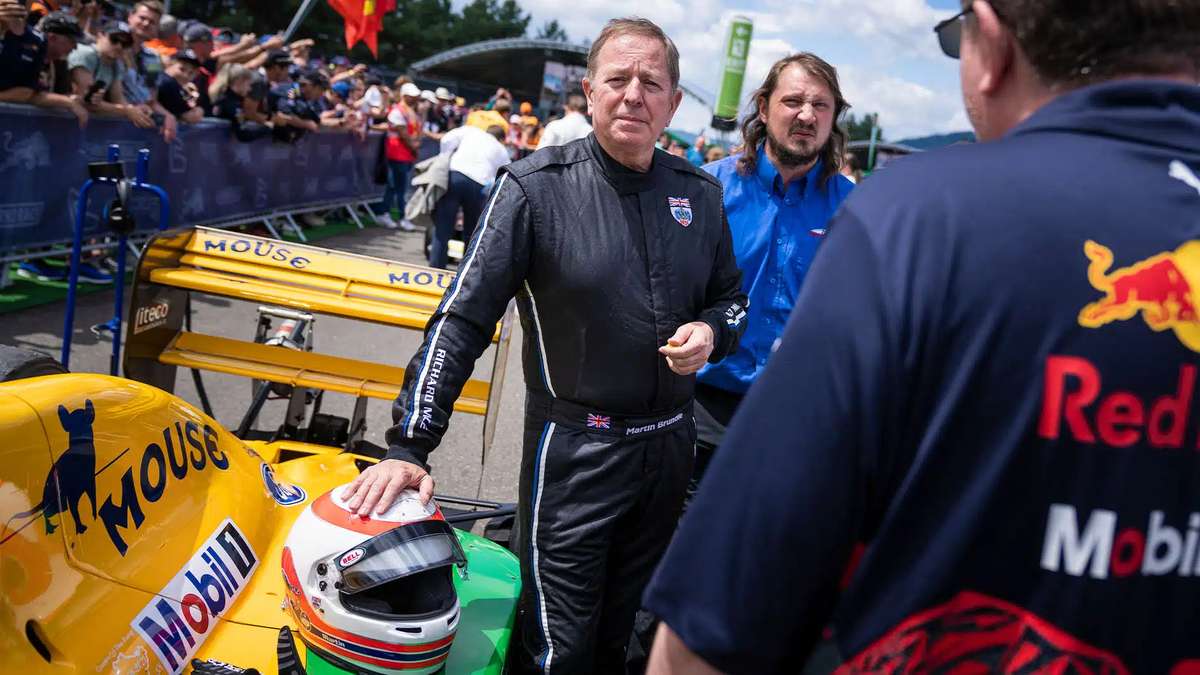
Brundle's Dallas injuries were severe: he broke both ankles and both feet and missed the remainder of that season while recovering, with initial medical concern for his left foot. That medical reality forced a period of enforced reflection and rehabilitation. The verified record shows he later rebuilt his career, achieving sportscar success with victories in events such as the World Sportscar Championship and Daytona 24 Hours in 1988. This trajectory is an empirical example of how injury and recovery can refine a driver's risk calculus: physical limits, confidence restoration and tactical patience all adjust after a major accident.
Bravery versus calculated risk: reading the balance
The verified sources allow a cautious interpretation: Brundle's early career displays episodes where either circuit context or crowded race situations exposed him to disproportionate risk, and his later successes in sportscars and longevity in motorsport indicate a capacity to adapt. Public reflections and interviews referenced in the verified material show he has spoken about the Dallas crash and the 'lost' aspects of 1984 candidly. From this we can reasonably infer a shift from raw aggression toward a more measured, experience-informed approach — a distinction between courage to commit and the calculation to preserve a career.
How elite drivers reduce avoidable errors: lessons from Brundle's path
- Constrain commitment where escape margin is low: the Dallas case highlights the need to adapt brake and turn-in aggression to circuit runoff.
- Use practice to calibrate risk, not to exceed it: repeated practice incidents around Monaco emphasise that lap-by-lap confidence building is preferable to single-lap maximal gambles.
- Prioritise recovery protocols after injury: Brundle’s successful return and sportscar victories after severe injuries show how medical recovery and targeted race programmes rebuild capability without reckless repetition.
- Refine start and restart strategy: the 1987 Austria start incident demonstrates why drivers must balance assertiveness and situational restraint in crowded opening phases.
Conclusion: temperament, limits and a reconstructed career
Martin Brundle's documented early-career crashes — most prominently Dallas 1984, plus other 1984 incidents and the 1987 start collision — provide concrete case studies of where Formula 1 risk concentrates and how a driver adapts. The severe injuries and the subsequent return to competitive success in sportscar racing form a factual backbone for the view that experience, enforced reflection and physical rehabilitation reshape a driver's relationship with the limit. Brundle’s later public reflections and long career in motorsport commentary further supply a first-person vantage on the lessons a driver draws from such episodes: that surviving the edge requires both technical learning and psychological recalibration.
Author: Eric M.