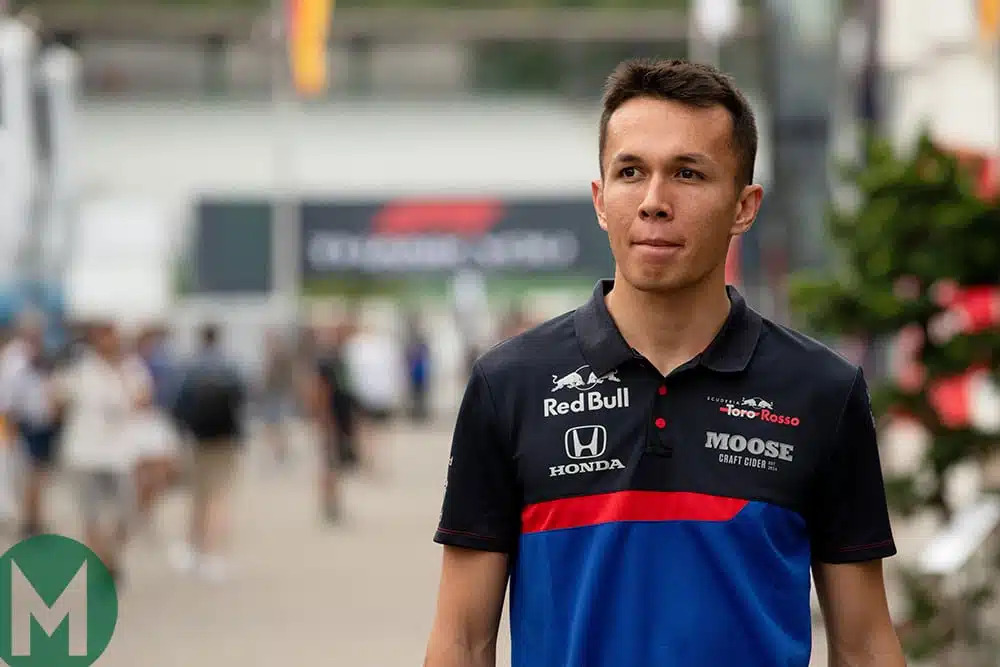
Alex Albon: what tense moments reveal about his temperament and limit management
Alex Albon's career arc — promotion to Red Bull, the strain of driving a car tailored around another team-mate, then a return to form at Williams — offers a clear case study of how pressure, car behaviour and team environment shape a driver's judgement at the limit. This article examines where crash risk appears in modern F1 and how Albon's documented experiences illuminate the balance between aggression and control.
Summary: Public reporting shows Albon experienced rear-instability and confidence issues at Red Bull after his 2019 promotion, then rebuilt a more comfortable, limit-driven style at Williams. He has discussed self-imposed pressure and a learnable approach to managing the edge.
Where Formula 1 risk really lives
Risk in Formula 1 concentrates at the car–tyre–track interface and in moments of high negotiation: heavy braking into tight corners, wheel-to-wheel duels, first-lap congestion and changing-wet conditions. For a driver, the subjective sense of when the car will step out — understeer, snap oversteer, or rear instability — is fundamental to deciding how far to push.
In Albon's case the verified record points to a specific technical-pressure interaction: his promotion to Red Bull in 2019 exposed him to a car whose rear behaviour and "pointiness" were reported as difficult for him to adapt to. That mismatch between driver habits and car characteristics amplified risk by reducing the margin for error in rear grip transitions.
Reading the edge of grip
Reading the limit requires combining sensory feedback with prior experience on that car. Drivers monitor tyre bite through steering effort, throttle load, yaw sensations and brief changes in direction under braking. Where a car is "pointy" at the rear, small inputs can produce large yaw responses — raising the chance of a snap that must be caught with opposite lock and throttle modulation.
Public analysis of Albon's time at Red Bull emphasises this sensitivity: the car's rear instability affected his confidence and performance. That is not a judgement of style alone but an observation about how vehicle characteristics change the sensory cues drivers rely on to find the limit.
Braking commitment and escape margin
Braking is where commitment becomes measurable: a driver chooses how late to brake and how much margin to leave for a recovery. When a car understeers into a corner or the rear steps out on turn-in, the available escape routes are limited by track layout, barriers and surrounding cars.
Reports and interviews with Albon describe phases when he felt under pressure to extract performance at Red Bull, which increased the psychological cost of leaving margin. Later, at Williams, he has spoken about rebuilding confidence — a process that typically allows drivers to trust small margins more because they better understand when the car will respond to corrective inputs.
Wheel-to-wheel judgment
Close racing compresses the decision window: line choice, reference points and tolerance to contact all change. A driver who has struggled with a particular car trait (for instance, rear instability) must either adapt the defensive/offensive lines or accept greater risk when locking the car at the limit.
The verified record shows Albon experienced notable incidents during various seasons that attracted media attention and stewarding review. While specific incident-by-incident causes are not consolidated here, those episodes emphasise how car behaviour, split-second decisions and pressure intersect in wheel-to-wheel scenarios.
Wet conditions and changing track state
Rain multiplies uncertainty: grip levels evolve lap-to-lap, standing water creates aquaplaning risk, and visibility reduces reference cues. Drivers must quickly recalibrate braking points and throttle openings; aggressive inputs that work on a drying line can become catastrophic on a cold or damp patch.
Public commentary about Albon's career does not provide detailed wet-weather incident lists here, but the general principle is clear: regaining confidence in unstable conditions is often about rebuilding trust in the car and in the team's setup choices — something Albon has described happening after his move to Williams.
Starts, restarts and first-lap risk
First laps are high-density moments where braking, steering and situational awareness collide. Drivers manage the limit differently at starts: some give up a little edge to avoid contact, others accept tighter margins to gain positions. Pressure — from team expectations or race context — can nudge a driver toward riskier choices.
Albon's public narrative includes reflections on self-imposed pressure, which helps explain how his decision thresholds shifted between teams. Where the car accentuated instability, the safer choice was often to adjust approach rather than attempt identical margins to those used in a more forgiving chassis.
How experience changes the equation
Experience brings three concrete gains: a larger internal database of how the car reacts in edge states, a refined feel for tyre life and grip windows, and an improved psychological filter for sorting urgent risks from acceptable gambles. Interviews and reporting show Albon explicitly linking regained confidence at Williams with a more instinctive, limit-driven style.
Between 2019–2020 Albon faced a steep learning curve at Red Bull; after leaving and later returning with Williams, he described a process of rebuilding confidence that allowed him to drive more comfortably at the limit. This illustrates a broader truth: drivers can become better calibrated over time, but only if the team environment and car behaviour support predictable feedback.
Bravery versus calculated risk
There is a practical distinction between bravado and calculated risk. Bravery is a trait visible in willingness to commit; calculation is visible in how a driver structures margin, monitors tyre and telemetry cues, and adjusts when the car feels different. Reporting on Albon's style repeatedly frames him as aggressive but maturing — learning to channel commitment into controlled exploitation of the car's window.
That maturation is visible in the verified sources as a change of environment and confidence restoration: when a driver moves from a setup that exposes them to sharper rear behaviour to a car and team that help them rebuild trust, the tendency is to replace panic-corrective reactions with pre-emptive adjustments and better judgement under pressure.
Takeaway: Albon's trajectory — the 2019 Red Bull promotion, the difficult adaptation to a rear-sensitive car, and the later restoration of confidence at Williams — shows how car characteristics and team environment shape a driver's risk envelope. Experience plus predictable feedback narrows error and turns aggression into usable pace.
Author: Eric M.