How Miami Formula One Stands Apart: Track Profile, Setup Compromise and Race…
The Miami International Autodrome — the temporary/semi-permanent circuit laid out around Hard Rock Stadium — arrived on the F1 calendar as a deliberate mixture of long straights and a twisty infield. That combination creates clear contradictions for teams and drivers: low drag to reach the high speeds down the straights versus higher downforce and mechanical grip for the technical middle sector. Understanding those contradictions is the quickest way to see how the Miami Grand Prix shapes strategy and on-track action.
Quick summary: Miami International Autodrome — approx. 5.412 km, 19 turns, counter-clockwise — pairs three long straights with a low-speed, kerb-heavy infield. The layout forces aerodynamic and mechanical compromises and concentrates overtaking into a few clear zones.
Quick access: Circuit identity · Speed profile · Setup trade-offs · Overtaking & DRS · Closing interpretation
FIRST READING OF THE CIRCUIT
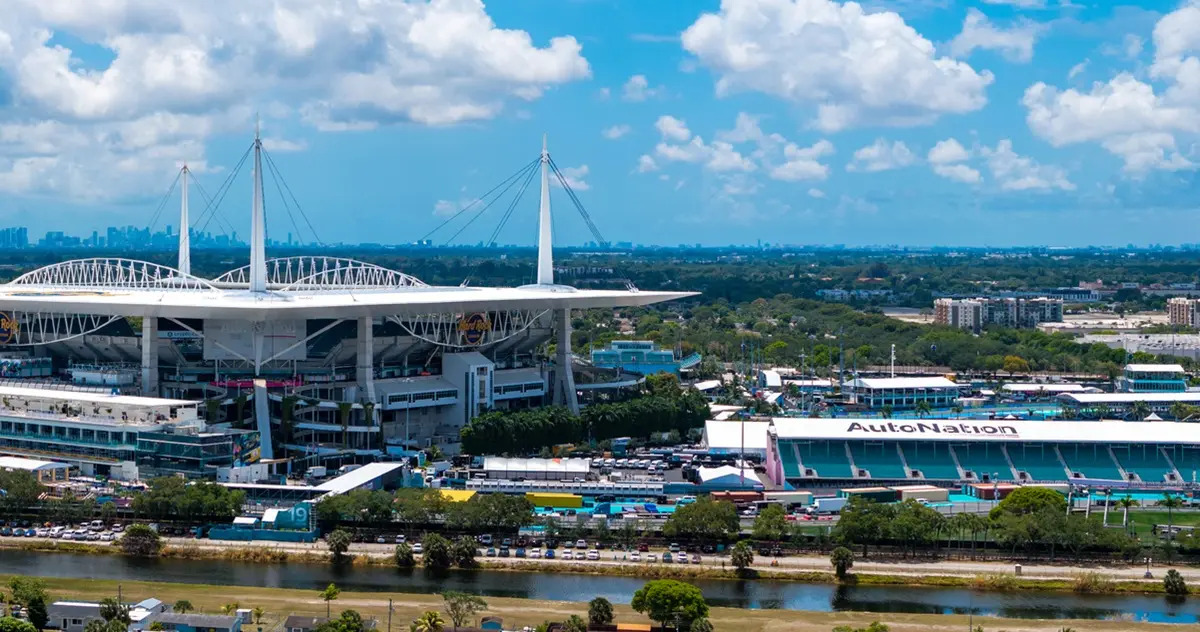
At first glance the Miami International Autodrome presents as a purpose-built event circuit grafted onto stadium grounds. The measured facts clarify that identity: a roughly 5.412 km counter-clockwise lap with 19 turns laid out around Hard Rock Stadium. That dual nature — partly constructed across parking areas and perimeter roads — explains the track’s hybrid personality: long, clean straights and wide-access zones that invite speed, followed by an intentionally tight, technical infield.
CORNER RHYTHM AND SPEED PROFILE
The lap is defined by three long straights separated by sections with contrasting demands. Early in the lap there are higher-speed sweepers where aerodynamic efficiency and stability matter. The middle sector funnels into a sequence of slower, technical corners (notably the infield around Turns 11–16) where braking precision, mechanical grip and transient response govern lap time. The alternation between high-speed direction changes and low-speed precision creates a rhythm of power, lift and reapplication that teams must map across a single lap.
BRAKING ENERGY AND TRACTION DEMANDS
The layout contains several heavy braking references where drivers convert high-speed momentum into late braking points ahead of tight infield corners. Those moments demand stable brake bite and predictable rear-end behaviour on corner exit. Traction becomes critical exiting the slow sequences into the following straights: a good launch out of the infield materially affects top speed windows and the ability to defend or attack on the run down to the next braking zone.
KERBS, SURFACE, AND TRACK EVOLUTION
Because the Miami circuit uses a mix of purpose-built sections across parking areas and existing perimeter roads, surface characteristics are variable. That variability shows up as differing grip levels and influences balance through the weekend: sessions typically reveal which lines and kerb choices work as the asphalt beds in. The infield’s kerb usage is notable — drivers report sensitivity to kerbs there, and small errors on kerbs or line precision can produce instability or sudden loss of grip.
SETUP TRADE-OFFS AND CAR COMPROMISES
Miami forces a textbook compromise. The three long straights reward low aerodynamic drag and longer gearing to reach top speeds approaching the high 200s to around 320 km/h in race trim, while the tight infield requires downforce, responsive damping and mechanical grip. Teams therefore balance rear stability for high-speed direction changes against the need for quick turn-in and traction in slow corners. Tyre pressures, anti-roll balance and ride settings are adjusted to mitigate kerb-induced instability without excessively increasing drag on the straights.
OVERTAKING, DRS, AND RACECRAFT
The circuit’s long straights create obvious overtaking opportunities. Published guides and the official circuit notes identify multiple DRS zones and primary passing chances into Turn 1, Turn 11 and Turn 17 at the ends of the long straights. Racecraft therefore tilts toward strong straight-line speed and tow management: producing a better exit from the infield and using DRS on the following straight are frequent routes to a pass. The contrast between the slipstream battles on the straights and the precision of the braking zones makes track position and timing critical.
HISTORICAL AND COMPETITIVE CONTEXT
The Miami Grand Prix debuted in May 2022 after the circuit name Miami International Autodrome was announced in September 2021. From the outset the venue was positioned not only as a sporting challenge but as a high-profile entertainment event, built around stadium infrastructure and fan zones. That commercial and spectacle layer has become part of the circuit’s identity alongside its technical demands.
CLOSING INTERPRETATION
In practical F1 terms Miami is a modern compromise circuit: it rewards top-speed efficiency while penalising mistakes in a kerb-heavy infield. Teams that find a balanced compromise between low drag and usable downforce, and drivers who can extract clean exits from the twisty sector, tend to convert pace into race position. Equally important is how the venue’s mixed surfaces and stadium setting shape weekend evolution — what looks fast on Friday can behave differently by Sunday as grip consolidates. The result is a track that produces clear tactical choices and concentrated overtaking windows, and whose spectacle combines genuine racing variables with an entertainment-first staging.
Author: Alex R.