What Defines the F1 Mexico City Grand Prix: How Autódromo Hermanos Rodríguez…
The Autódromo Hermanos Rodríguez in Mexico City is one of Formula 1's most distinctive venues. Sitting at roughly 2,200–2,240 metres above sea level, the circuit pairs a very long straight with a slow, enclosed stadium sequence — a combination that forces teams into clear compromises on downforce, cooling and tyre management. Understanding those trade-offs is the key to reading how a Mexican Grand Prix weekend unfolds.
Quick summary: Mexico City demands a top-speed/low-drag compromise because of high altitude and a very long main straight, while the technical stadium sector makes mechanical grip, braking stability and traction crucial. Tyre degradation is relatively low; strategy and cooling choices are shaped principally by reduced air density.
Quick access:
First reading of the circuit · Setup trade-offs · Overtaking and DRS logic
FIRST READING OF THE CIRCUIT
At first glance Autódromo Hermanos Rodríguez reads as a high-altitude speed track with a contrasting slow infield. The altitude — roughly 2.2 kilometres above sea level — reduces air density and therefore aerodynamic downforce and drag. That reduction alters the relative value of aerodynamic grip versus mechanical grip: teams can achieve higher top speeds down the circuit's long straight, but they lose the proportionate downforce that normally helps through medium- and high-speed corners.
CORNER RHYTHM AND SPEED PROFILE
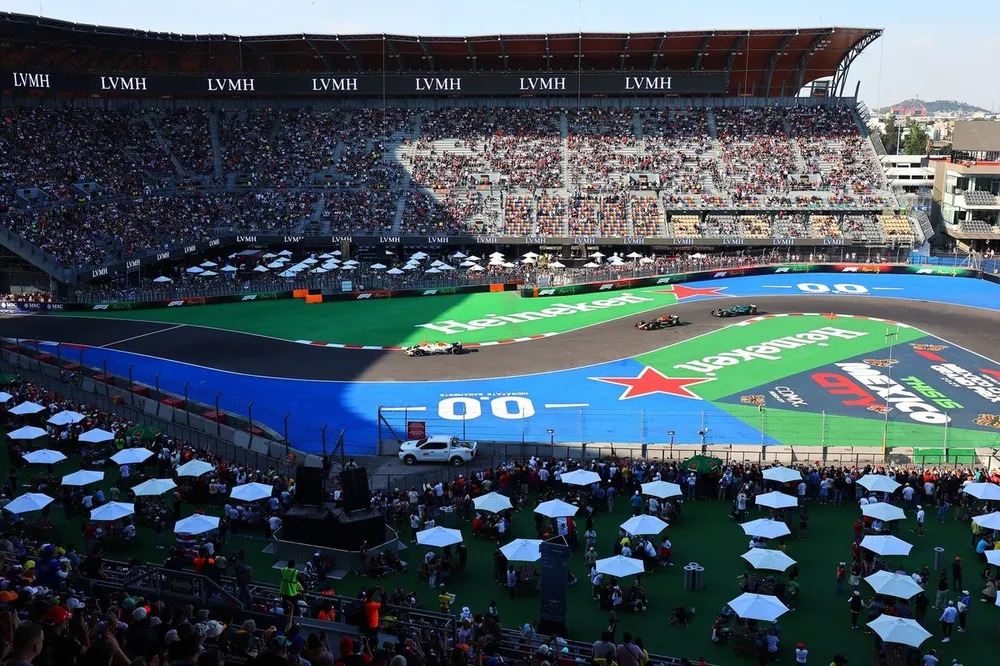
The lap splits into three clear parts: a high-speed opening sector that rewards low drag and engine power, a technical middle sector of mixed-speed corners, and the slow Foro Sol stadium complex at the end of the lap. The long main/back straight lets cars reach very high top speeds — modern F1 cars have exceeded speeds in excess of typical 350 km/h figures there — making straight-line performance a major factor for lap time. Conversely, the stadium section is low-speed and densely packed with direction changes, so time gained on the straight can be offset by losses if a car lacks mechanical balance and traction through the slow turns.
BRAKING ENERGY AND TRACTION DEMANDS
Heavy braking zones at the end of the long straight and into the stadium hairpins are decisive. The long run to the first heavy-braking complex provides overtaking opportunity but also stresses brake cooling choices at altitude, where thinner air reduces convective cooling. The stadium sector emphasises braking stability and precise throttle application: drivers must manage weight transfer and traction on corner exits where aerodynamic assistance is reduced. Those exits are crucial because poor traction there immediately compromises speed down the following straight.
IMAGE
SETUP TRADE-OFFS AND CAR COMPROMISES
Teams face a clear compromise: lower downforce to capitalise on the long straight versus higher downforce and mechanical setup to tame the slow Foro Sol sector. The reduced aerodynamic effectiveness at altitude makes suspension tuning and mechanical grip comparatively more influential. Cooling also becomes a setup variable — engines and brakes receive less airflow for cooling due to thinner air, so radiator and brake duct choices interact with aerodynamic drag and overall balance.
TYRES, THERMAL LOAD, AND STINT SHAPE
Pirelli and teams typically treat Mexico City as a lower-degradation circuit because the track does not generate the same thermal and aerodynamic tyre loads as high-downforce venues. However, tyres still require careful warming in the stadium sector, where lower speeds and mechanical grip influence tyre temperatures. Strategy planning therefore accounts for generally lower wear but localised stress where drivers push hard out of slow corners.
OVERTAKING, DRS, AND RACECRAFT
The dominant overtaking window is the heavy-braking zone at the end of the long straight. Slipstreaming combined with DRS on the main straight has historically enabled passes. Additional opportunities appear into the slow hairpins of the stadium complex, where late braking and good traction on exit can win a position. Because aerodynamic downforce is reduced at altitude, following a car closely on the straight produces a strong tow effect, but in the stadium sector a chasing car must rely on mechanical grip and precise braking to convert a slipstream into a pass.
HISTORICAL AND COMPETITIVE CONTEXT
The Mexico City event is widely recognised for its stadium atmosphere — often marketed around the Foro Sol experience — which reinforces the circuit's identity as a crowd-focused venue. From a competition standpoint, the track's high average speeds, extreme top speeds on the main straight and the slow stadium sector combine to reward cars that find an effective low-drag compromise without sacrificing predictable mechanical balance for the infield.
CLOSING INTERPRETATION
In concrete F1 terms, Autódromo Hermanos Rodríguez is a compromise circuit where altitude shifts the balance from aero domination toward a mixed solution: exploit the long straight with low drag and strong power-unit performance, but preserve mechanical grip, braking stability and traction for the stadium sector. That duality shapes qualifying priorities, race strategy and setup choices across a weekend — and it is precisely this tension between very high top speed and tight, slow corners that gives the Mexican Grand Prix its technical identity.
Author: Eric M.