What makes the Australian Grand Prix identity at Albert Park: rhythm, setup…
The Australian Grand Prix at Albert Park is a temporary street/parkland circuit in Melbourne assembled from public roads each year. Since the major reprofiling introduced from 2022, Albert Park presents a faster, more flowing character with higher mid‑corner speeds, new long high‑speed stretches and multiple DRS opportunities. Understanding the track in concrete F1 terms means knowing where time is made, what the car must compromise to achieve balance, and which sectors shape qualifying and race strategy.
Quick summary: Albert Park is a rebuilt temporary circuit that now trades tighter, stop‑start feel for longer, faster sequences. The 2022+ changes removed a mid‑section chicane, added a roughly 1.3 km high‑speed zone, and increased average lap speed while keeping the surface and kerbs of a public‑road venue.
Quick access:
FIRST READING OF THE CIRCUIT
At first glance Albert Park now reads as a hybrid between a parkland street circuit and a semi‑permanent fast track. The temporary public‑road nature remains central: the surface is rebuilt annually from public roads, which influences grip and mechanical compliance. The 2022 and subsequent reprofiling removed a mid‑section chicane and reprofiled multiple corners, deliberately shifting the venue toward higher average speeds and a more flowing lap while keeping the narrow, kerb‑heavy character of a street/park circuit.
CORNER RHYTHM AND SPEED PROFILE
The revised layout creates distinct rhythm shifts. Where the old design interrupted momentum with a mid‑sector chicane, the new flow offers longer high‑speed runs and faster mid‑corner velocities. One notable consequence is a roughly 1.3 km high‑speed zone where cars can exceed 300 km/h; that stretch lengthens the time spent in top‑speed trim and raises average lap speed compared with earlier configurations.
Despite that long sector, the circuit retains multiple medium/fast sequences such as the reprofiled Lakeside Drive area and the fast approach into what teams identify as Turns 11–13. These sequences require sustained lateral stability and precise transition management: carrying speed through a chain of quick changes is where a lap is won or lost.
BRAKING ENERGY AND TRACTION DEMANDS
Albert Park now shifts the balance toward later braking in several key places because of higher mid‑corner speeds. The reprofiling produces later brake markers and higher entry speeds into some turns, increasing the demand on brake cooling and modulation during qualifying and race stints. At the same time, traction out of medium‑speed corners remains a critical trait: the long high‑speed section amplifies the reward for clean exits where slipstreaming and ERS deployment can be effective.
KERBS, SURFACE, AND TRACK EVOLUTION
The temporary public road surface offers low initial grip that improves across the weekend as rubber is laid down. Kerb profiles have been actively managed: safety‑driven tweaks — notably to Turns 6 and 7 after heavy incidents — changed kerb geometry and corner profiles following FIA review. That combination of evolving grip and kerb sensitivity pushes teams to favour suspension compliance that tolerates kerb riding while avoiding damage or instability over bumps.

TYRES, THERMAL LOAD, AND STINT SHAPE
Documented observations indicate that tyre degradation at Albert Park is often relatively low, particularly as the surface builds grip over the weekend. Lower degradation makes longer stints and one‑stop strategies credible, but tyre energy still matters because of the mix of medium and high‑speed sectors plus aggressive kerb usage. Thermal management is therefore about maintaining consistent tyre temperatures during the long high‑speed run without overworking the structure on repeated heavy lateral loads.
SETUP TRADE-OFFS AND CAR COMPROMISES
Teams face a classic compromise: enough downforce and stability for the many medium/fast corners and quick sequences, but not so much drag that the car loses time on the long ~1.3 km high‑speed zone. Public‑road surface and kerb aggression push setups toward mechanical compliance and predictable ride behaviour, making suspension settings and damping critical. The practical choice for most teams has been a balanced or medium‑downforce package tailored to traction and kerb‑ride stability rather than an extreme low‑drag solution.
These trade‑offs affect qualifying and race trim differently. In qualifying, finding peak mid‑corner grip and maximal exit speed can justify slightly higher downforce, while race setups often soften that edge to protect tyres and improve straight‑line efficiency over laps where tyre life becomes decisive.
OVERTAKING, DRS, AND RACECRAFT
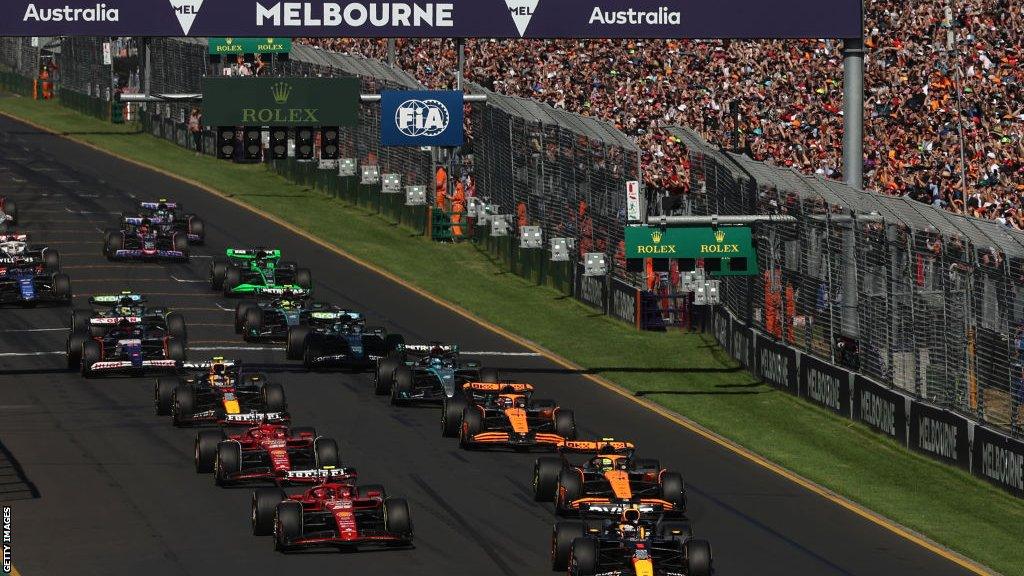
Historically Albert Park offered limited overtaking, so the reprofiling targeted clearer passing opportunities. Official guides report multiple DRS zones (four reported in event materials), and the long high‑speed stretch created by the changes provides a meaningful slipstream and ERS/drag trade‑off area. As a result, qualifying position remains important, but the reprofiled approaches — particularly into the Lakeside Drive area and the fast sequence into Turns 11–13 — are the places where overtakes are most likely to be attempted when slipstream and DRS align.
Racecraft therefore concentrates on clean exits from medium‑speed corners to set up runs into the long straight and on managing energy deployment across the fast sector. Because tyre wear is often manageable, drivers can exploit one‑stop strategies and time attacks, but the value of track position stays high on a venue where clean high‑speed runs convert to overtaking chances.
HISTORICAL AND COMPETITIVE CONTEXT
Albert Park’s identity has evolved from earlier revisions that began in response to faster F1 cars after 2017. The 2022 and later reprofilings are explicit attempts to increase overtaking and average speed, with simulations and reporting indicating substantially faster lap times after the changes. Safety‑led adjustments after heavy incidents in 2024 led to further tweaks at Turns 6 and 7, reflecting the venue’s ongoing adaptation to modern car performance and driver feedback.
CLOSING INTERPRETATION
The Australian Grand Prix at Albert Park now reads as a faster, more flowing circuit that still carries the technical fingerprints of a temporary street/park venue: evolving grip, kerb reliance, and narrow lines. The 2022+ layout changes — the removal of the mid‑section chicane, the long high‑speed zone and multiple DRS opportunities — reshaped the track’s competitive personality. In practical terms teams must thread a needle between downforce and drag, manage tyre energy across mixed sectors, and prioritise clean exits that set up the long high‑speed run. That combination makes Albert Park an instructive early‑season test of a car’s balanced performance and a weekend where qualifying and setup judgement remain decisive.
Author: Cynthia D.