F1 DRS explained: How the Drag Reduction System works and changed racing
DRS — the Drag Reduction System — is one of the most visible technical and strategic tools in modern Formula 1. Introduced as an overtaking aid in 2011, DRS is a driver‑controlled movable flap on the rear wing that, when used under the rules, reduces aerodynamic drag to increase top speed and make passing easier.
Quick summary: DRS opens a rear‑wing flap to reduce drag, is allowed only in marked activation zones, requires race control to enable it, and in races the pursuing car must be within one second at the detection line to activate it. It can be used freely in practice and qualifying in those zones.
Quick access:
CLEAR DEFINITION
DRS stands for Drag Reduction System. It is a movable aerodynamic device—a flap in the rear wing—that drivers can activate to reduce drag and raise top speed. The system was introduced to Formula 1 in the 2011 season specifically as an overtaking aid.
HOW IT WORKS
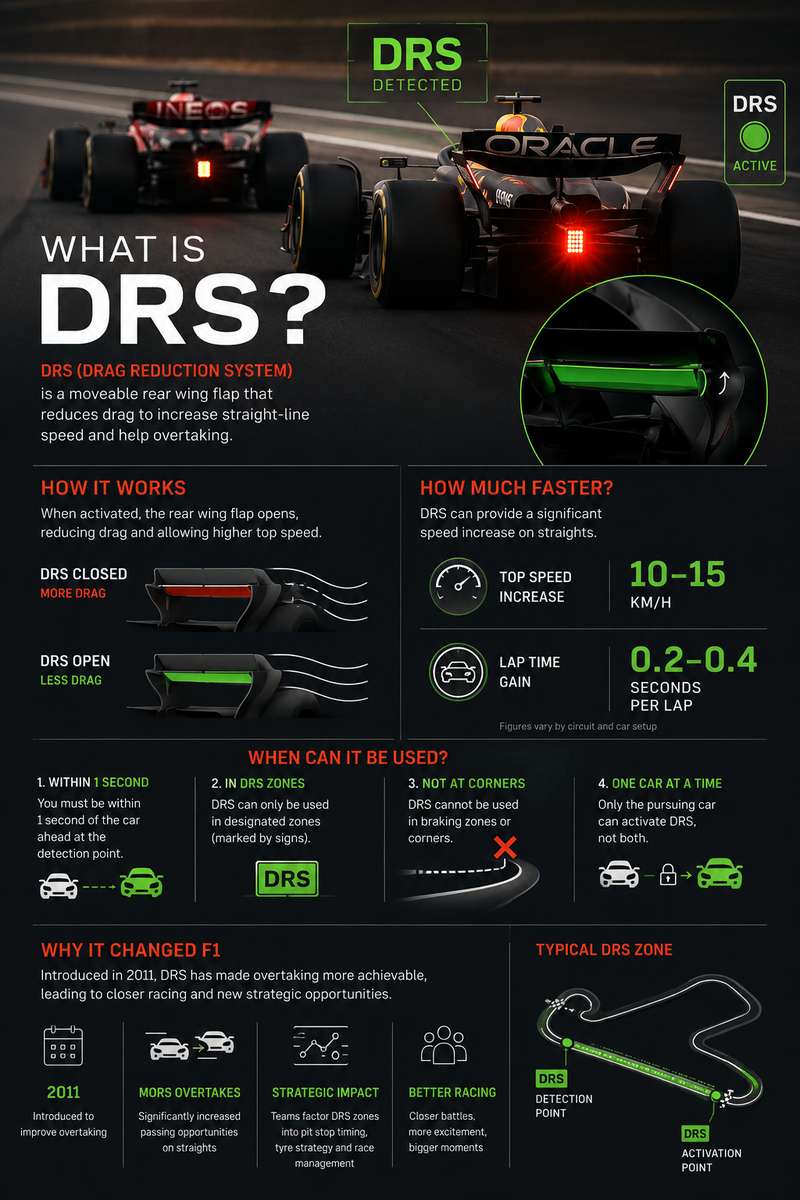
When DRS is activated the rear wing flap opens, lowering the wing's angle of attack and cutting aerodynamic drag. With less drag the car reaches a higher top speed on a straight, which narrows the speed gap between a following car suffering from 'dirty air' and the car ahead. The mechanical change is simple; the on‑track effect is a measurable boost in straightline speed that increases the chance of completing a pass.
RULES AND WHEN IT CAN BE USED
DRS use is governed by sporting regulations and controlled by race control. Circuits have pre‑determined DRS activation zones marked on the track. Race control must enable DRS for a session or race; it can be disabled if conditions are unsafe. In race sessions a pursuing driver may activate DRS only if they are within one (1) second of the car ahead when they cross the detection line, which is placed before the activation zone.
In practice and qualifying the one‑second restriction does not apply: drivers may use DRS in the designated zones during those sessions when race control has enabled it.
SAFETY CONDITIONS AND CONTROL
Race control can disable DRS for safety reasons. Specified conditions—such as yellow flags shown in an activation zone or other visibility or safety concerns—prevent activation. The system’s availability at any moment is therefore a combination of circuit markings, detection logic and the match‑day decision of the officials.
STRATEGY AND RACECRAFT
DRS changed how teams think about overtaking and strategy. With reliable DRS zones, teams consider where passes are most likely and may time pit stops and tyre choices around opportunities to use DRS later in a stint. Drivers chasing another car plan their approach to cross detection lines within the one‑second window to gain the straightline advantage into activation zones.
At the same time, DRS reshaped defensive driving: leading drivers will adjust braking points, exit lines and corner speeds to make placement into the detection point less favorable for the chaser. The result is a tactical interaction between drivers and teams over laps, not just raw pace.
CAR BEHAVIOUR AND TECHNOLOGY
The aerodynamic effect of DRS is clear: reduced drag lowers downforce at the rear wing when open, so cars feel different under braking and high‑speed stability immediately after deactivation. Teams design rear wings and balance around the existence of DRS zones, since the device is part of the overall aerodynamic package and race plan.
HISTORICAL CONTEXT
DRS was introduced in 2011 and was widely credited with increasing overtaking opportunities. Its arrival prompted debate about whether overtakes were 'artificial' or acceptable within modern aerodynamics; nonetheless, DRS rapidly became a central tactical element. In the mid‑2020s the FIA and Formula 1 continued to adjust regulations and aerodynamic concepts, and readers should consult the current FIA Sporting and Technical Regulations for season‑specific details.
COMMON MISUNDERSTANDINGS
Beginners often think DRS guarantees a pass; it does not. DRS makes overtaking more likely by increasing top speed, but track layout, tyre condition, car balance and defensive driving determine whether a pass is completed. Another frequent mistake is assuming DRS works everywhere—its effect only applies in the marked activation zones and is subject to detection, session and safety rules.
FAN VIEWING GUIDE
On TV you can spot DRS use when timing screens show the activation zones and when onboards or replays show the rear wing flap visibly open on straights. Broadcasters often indicate when a driver is within one second at the detection point and when race control has enabled DRS—those are the two conditions fans should watch to predict an attack.
CLOSING INTERPRETATION
DRS is a compact technical device with outsized sporting impact: a simple movable flap that changed overtaking statistics, race strategy and car development. Understanding how DRS is enabled, where it can be used and how it interacts with tyres, dirty air and driver tactics helps viewers read races more intelligently. It remains an explicit example of how rules, aerodynamics and racecraft combine to shape modern Formula 1.
Author: Alex R.