How Yuki Tsunoda expresses his personality on track: risk, precision and…
Yuki Tsunoda's presence in Formula 1 reads as a compact study in contrasts: a naturally aggressive racer who has been told to temper his instincts, and a technically sensitive driver who can adapt quickly to car and circuit. This piece breaks down how that on-track personality shows up across braking, cornering, tyre management, qualifying and race behaviour — using documented reporting and public career patterns as the evidence base.
Tsunoda combines an attack-oriented natural style with documented advice from team figures to moderate risk; he pairs that temperament with an ability to sense car limits and extract strong single-lap and race-weekend performance.
First technical reading of the driver
The documented portrait of Tsunoda highlights two immediate technical impressions. First, he arrived in F1 with an aggressive, high-risk approach that produced several early crashes and led to internal and public calls for him to "calm down". Second, multiple profiles and Tsunoda's own comments emphasise his rapid adaptability and sensitivity to a car's behaviour — traits associated with good long-run consistency and setup communication.
Those two strands — attack and adapt — form the baseline for interpreting his inputs at the wheel: a driver who will seek performance through committed phases but can also read the balance and alter his approach when needed.
Braking, release, and corner entry
Public reporting records early incidents that prompted team figures to advise moderation. From a technical perspective that pattern commonly manifests as very late braking attempts and strong front-end commitment: an attempt to maximise entry speed and rotation, accompanied by a higher risk of locking, misrotation, or running wide when the grip threshold is exceeded.
Because senior figures publicly advised him to avoid pushing unnecessarily in early qualifying sessions, the observable lesson is clear: when Tsunoda moderates the entry aggression he reduces error risk and preserves laps. That management is not a denial of his technique but a calibrated change in risk profile driven by team strategy and experience.
Mid-corner shape and minimum speed
Profiles and driver commentary indicate Tsunoda can run consistent long runs and feel a car's limitations. Technically, that suggests an ability to find and hold a minimum-speed platform through the middle of a corner rather than repeatedly hunting single high-risk apexes. The practical consequence is more repeatable lap times across a stint and better prediction of tyre degradation — both important for race stints and tyre strategy.
That said, his baseline tendency toward attacking entries can still put pressure on mid-corner stability if the setup or track conditions do not allow easy forgiveness, which is why moderation is part of the developmental narrative.
Exit traction and tyre management
Sources highlight Tsunoda's capacity to run consistent long runs, a sign of measured throttle control and sensitivity to rear grip over a stint. Drivers who can feel a car's limits typically preserve rear tyres by managing slip and avoiding aggressive throttle spikes on corner exits — an ability that helps race durability and stint predictability.
Conversely, an aggressive core instinct can produce moments where traction application is sharper and more wheelspin-prone, particularly when attempting overtakes or minimum-stop qualifying laps. The public record shows the balance between conserved stint pace and intermittent aggression has been a feature of his weekends.
Qualifying profile and one-lap risk
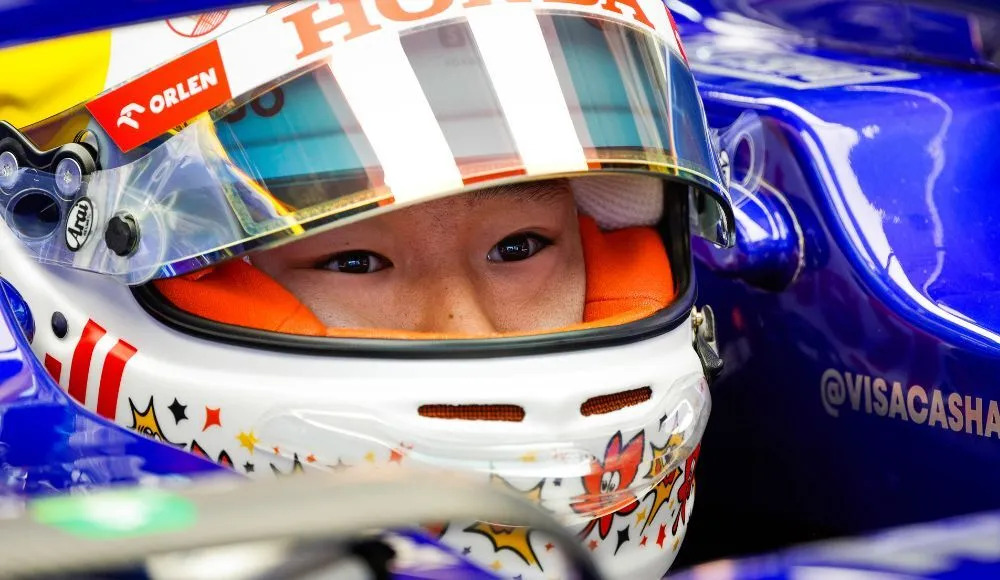
Head-to-head season analyses and reporting indicate Tsunoda frequently performs well against teammates in qualifying and weekend metrics. That supports a view of him as a strong one-lap performer who can extract maximum from a car when it matters. At the same time, early-career incidents and team guidance around avoiding unnecessary pushing in early Q1 runs show that his one-lap approach has required calibration — choosing when to push the limit and when to protect a session.
The practical takeaway: Tsunoda can find single-lap speed reliably, but that speed carries a risk premium the team has sometimes asked him to reduce to protect the car and the weekend programme.
Racecraft, overtaking, and defensive IQ
Race coverage and decision documents record episodes where Tsunoda combined attacking racecraft with occasional penalties or incidents — a pattern that matches his profile as an aggressive, modern driver who sometimes oversteps. This mix has produced moments of strong race position and near-podium contention, alongside the cost of penalties or on-track infractions in certain events.
That behaviour is consistent with a driver who is willing to make bold moves but who has been learning to weigh immediate gains against longer-term weekend consequences — a learning curve acknowledged in journalistic profiles and team comments.
Feedback, development input, and team impact
Long-reads and team pages characterise Tsunoda as clear about what he wants from the car and able to adapt quickly. From an engineering perspective this is valuable: drivers who provide actionable feedback on balance and limits help engineers converge on setup more efficiently during a weekend. His documented ability to run consistent long runs further increases his usefulness for set-up and strategy work.
At the same time, the early need to change his risk profile underlines how driver behaviour feeds team priorities — preserving machinery and championship points can require tempering individual boldness for collective benefit.
Closing interpretation
Yuki Tsunoda's on-track personality is best read as a high-commitment talent learning to convert raw aggression into repeatable performance. The verified record shows a driver who began with high-risk instincts, received and heeded guidance to moderate that risk, and complements that attitude with genuine technical sensitivity and weekend extraction skills. That combination explains why he remains a compelling figure: capable of strong single-lap pace and valuable setup feedback, while still on a development trajectory to make his attacking impulses consistently productive rather than occasionally costly.
Author: Eric M.